



Blog
Industrial Water Damage Restoration: Rapid Drying for Operational Continuity
Industrial Water Damage Restoration: Rapid Drying for Operational Continuity
When water enters an industrial or commercial facility, the damage spreads faster than most teams expect. Within hours, moisture migrates into wall assemblies, insulation, electrical chases, flooring systems, and sensitive equipment. Within days, corrosion accelerates, coatings fail, and microbial growth becomes a serious operational and liability concern. Industrial water damage restoration is not simply “pumping and drying”—it is a coordinated process designed to stabilize the site, protect people, preserve assets, and return production to a controlled environment as quickly as possible.
First priority: safety, access control, and shutdown decisions
Before any drying strategy is deployed, the site must be made safe for entry. Industrial facilities introduce hazards that require disciplined controls: energized equipment, chemical storage, process piping, confined spaces, and elevated work areas. A rapid response still begins with a deliberate safety evaluation and a clear chain of command.
- Isolate power where water has contacted electrical panels, motors, or floor-level distribution; lockout/tagout should be used where applicable.
- Identify slip, trip, and fall risks, especially where a flooded basement or submerged pits conceal drains, steps, or floor openings.
- Screen for contamination sources (sewage, process water, chemicals). If present, treat the event as biohazard cleanup with appropriate PPE and handling protocols.
- Establish controlled access zones and traffic patterns to keep unaffected production areas separated from wet work zones.
These steps protect personnel and prevent secondary damage caused by uncontrolled movement, cross-contamination, or premature equipment restart.
Source control and extraction: stop the spread before you dry
Rapid drying is only effective after water intrusion is stabilized. Source control may involve shutting valves, isolating damaged piping, roofing temporary repairs, or coordinating with facility engineering to bypass compromised systems. For storm cleanup events, exterior drainage, loading dock thresholds, and door seals are common contributors that should be addressed early to prevent re-entry of water during ongoing weather.
Next comes bulk water removal. In large footprints, extraction is a production multiplier: every gallon removed reduces the vapor load that dehumidifiers must manage. High-capacity pumps, truck-mounted extractors, squeegees, and floor scrubbers are selected based on floor type, contaminants, and access. For multi-level facilities, vertical water migration must be considered—water on an upper floor can saturate ceiling systems and drop into lower operational zones.
Moisture mapping and documentation: the foundation of a correct drying plan
Industrial restoration requires measurement-based decisions. Technicians should map moisture conditions using a combination of thermal imaging, non-invasive meters, and targeted probe readings. This is where moisture control becomes actionable: you cannot manage what you do not quantify.
- Define wet materials and assemblies (concrete, CMU, drywall, insulation, wood blocking, raised flooring).
- Establish drying goals using unaffected “dry standards” from the same building where possible.
- Document conditions for internal reporting, insurers, and compliance needs (especially in regulated manufacturing environments).
Accurate mapping also supports decisions on selective demolition. In many industrial settings, removing compromised insulation or porous finishes early shortens downtime and reduces the risk of hidden microbial amplification.
Rapid structural drying at scale: airflow, dehumidification, and pressure management
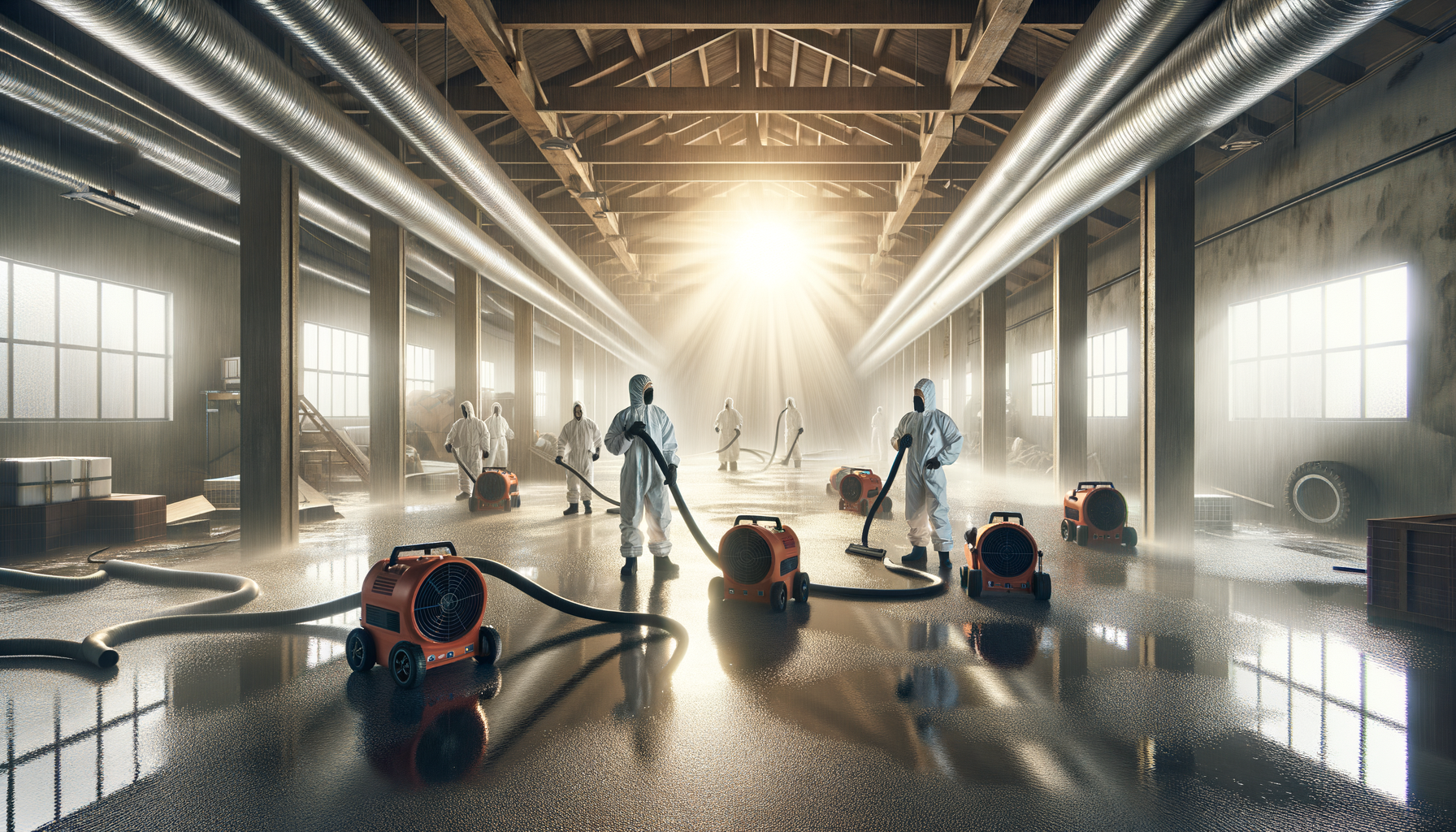
Effective drying is a balance of airflow, temperature, and dehumidification capacity. Large industrial volumes can mislead teams into under-sizing equipment; meanwhile, tight production spaces with machinery can restrict airflow and create persistent wet pockets. A high-performance drying plan typically includes:
- High-velocity air movement directed across wet surfaces and into known “dead zones” behind equipment lines and storage racks.
- Commercial-grade dehumidification matched to the building’s cubic footage and the moisture load; desiccant systems may be appropriate for cooler spaces or when low humidity targets are required.
- Strategic containment and pressure differentials to keep humid air and particulates out of clean operations, QA labs, or customer-facing areas.
Concrete drying is often the long pole in industrial losses. Moisture trapped under coatings, epoxy, VCT, or rubber flooring can cause adhesive failure and future blistering if not verified. Drying may require longer runtime, heat assistance, or removal of impermeable coverings to allow evaporation.
Mold prevention and verification: don’t let downtime become a second loss
Industrial facilities cannot afford a water event to turn into a mold event. Time, temperature, and material type determine risk. When porous materials remain wet or humidity stays elevated, microbial growth can begin quickly, complicating reopening and increasing liability.
Routine monitoring should include daily humidity tracking, moisture readings, and visual checks in concealed areas. If the facility is in the region and needs specialized evaluation, coordinating a mold inspection cincinnati service can help verify conditions, identify hidden amplification, and support clearance decisions when sensitive operations are involved.
Contamination scenarios: when restoration becomes biohazard cleanup
Not all water is equal. Sewage backups, river flooding, and certain process discharges require a different workflow. Biohazard cleanup involves controlled removal of impacted porous materials, targeted cleaning and disinfection, and strict waste handling. In these cases, drying is still critical—but only after contamination is addressed so that equipment does not aerosolize hazardous particles or spread pathogens.
Operational continuity: phased recovery and equipment protection
Industrial restoration succeeds when it aligns with production priorities. Phased drying and selective containment can keep critical lines operating while other zones are stabilized. Sensitive equipment should be evaluated for water exposure, corrosion potential, and safe re-energization. Coordination among restoration leads, facility engineering, EHS, and operations ensures that restart decisions are based on verified dryness, not schedule pressure.
With the right combination of safety controls, measurement-driven moisture control, and properly scaled drying systems, industrial water damage restoration can minimize downtime, protect assets, and restore a stable environment that supports reliable operations.
Need restoration help in Cincinnati?
TRI-WEH Restoration is a locally owned, IICRC-certified restoration contractor based in Cincinnati, Ohio, serving homes and businesses across Greater Cincinnati 24/7. If you need water damage restoration or air duct cleaning, call us any time at (513) 231-6653 or request service online.