



Blog
Water Damage Categories: What Category 1, 2, and 3 Mean
When a restoration crew walks into a building after a water loss, the first thing they establish is not how much water is there. It is what kind of water it is. That classification — Category 1, 2, or 3 — drives almost everything that follows: which materials can be dried and kept, which have to come out, what protective equipment the crew wears, and how the loss gets documented for your insurer. Here is what the three categories mean, why a category can change while you wait, and what each one implies for your property.
The categories come from the ANSI/IICRC S500 standard, the reference document professional water damage restoration contractors work to. They describe contamination, not volume. Two inches of clean supply-line water and two inches of sewage are the same amount of water and two completely different jobs.
The three categories, in plain terms
Category 1: sanitary water
Category 1 water comes from a sanitary source and does not pose a substantial risk from contact at the moment it escapes. A burst copper supply line, a failed water heater connection, a supply hose behind a washing machine, an overflowing tub with nothing in it, or rainwater that entered through a roof or window opening without picking anything up on the way.
In Greater Cincinnati, most Category 1 losses are plumbing failures, and they cluster in the cold months when an unheated crawlspace or an exterior wall run freezes and splits. A Category 1 loss caught quickly is the best-case version of this problem: most of what got wet can usually be dried in place.
Category 2: significantly contaminated
Category 2 water carries meaningful contamination and has the potential to cause discomfort or illness on contact. Common sources are discharge from a dishwasher or washing machine, a toilet overflow containing urine but no solid waste, water from a failed sump pump, aquarium water, or water that started clean and then passed through building materials and picked things up along the way.
This is the category people most often misjudge, because Category 2 water frequently looks fine. Clarity is not the test. The source and what the water has traveled through are the test.
Category 3: grossly contaminated
Category 3 is grossly contaminated water. Sewage backups, toilet overflows containing solid waste, rising water from creeks and rivers, and ground surface water that has entered the building all fall here. So does water from any source that has been sitting long enough to become seriously contaminated.
Cincinnati produced a large number of Category 3 losses in a single afternoon this summer. The July 17 storms dropped five to six inches of rain on parts of Hamilton County and generated more than 900 reports of sewer backups and basement flooding to the Metropolitan Sewer District, with debris removal concentrated in Hyde Park, Oakley, Madisonville, and California. Many of those property owners are still working through the aftermath now.
Category 3 water is treated differently because of what it can carry. The CDC notes that floodwater may contain human and livestock waste along with household, medical, and industrial hazardous waste, and that contact can lead to wound infections and gastrointestinal illness; its guidance is that the best way to protect yourself is to stay out of the water. If you have already been in it, that same CDC guidance is to wash with soap and clean water and to seek medical attention for any wound that shows redness, swelling, drainage, or fever. No contractor can tell you what a given exposure means for you personally — that is a question for a physician.
Categories do not hold still
A category is assigned at the time of inspection, and it can move in one direction: worse. Clean water that sits picks up contamination from whatever it touches — soil tracked into carpet, the contents of a base cabinet, whatever was on the floor of the storage room. Warmth and humidity speed that up.
That is the practical reason response time matters in the Ohio Valley between June and September. A basement that is already humid in late summer gives bacteria a comfortable place to multiply, and a Category 1 loss left over a long weekend is not necessarily a Category 1 loss when someone finally looks at it. The same clock applies to mold: the EPA’s guidance is that if wet materials are dried 24 to 48 hours after a leak or spill, in most cases mold will not grow.
It is worth knowing what that clock does not mean. There are no federal limits for mold or mold spores in indoor air — the EPA states plainly in that same guidance that no EPA or other federal limits have been set, which is why air sampling cannot be used to show that a building complies with a federal mold standard. Anyone quoting you a “safe” spore count is quoting a number that does not exist in federal regulation. If you have health concerns about mold in your building, the EPA’s own guidance is to consult a health professional.
What the category decides about your property
This is where the classification stops being terminology and starts costing money. The governing distinction is how porous a material is and which category of water reached it.
After a Category 1 loss, most materials can be dried in place. Carpet and pad are frequently salvageable. Drywall often stays, dried from behind by removing baseboard and drilling the cavity rather than cutting it out. Hardwood can sometimes be saved with specialized drying, though not always.
After a Category 2 loss, carpet pad is usually removed because it holds contaminated moisture and cannot be reliably cleaned in place. Carpet itself may be cleanable. Drywall that wicked water is often cut, and the decision depends on how far the moisture traveled and what is behind it.
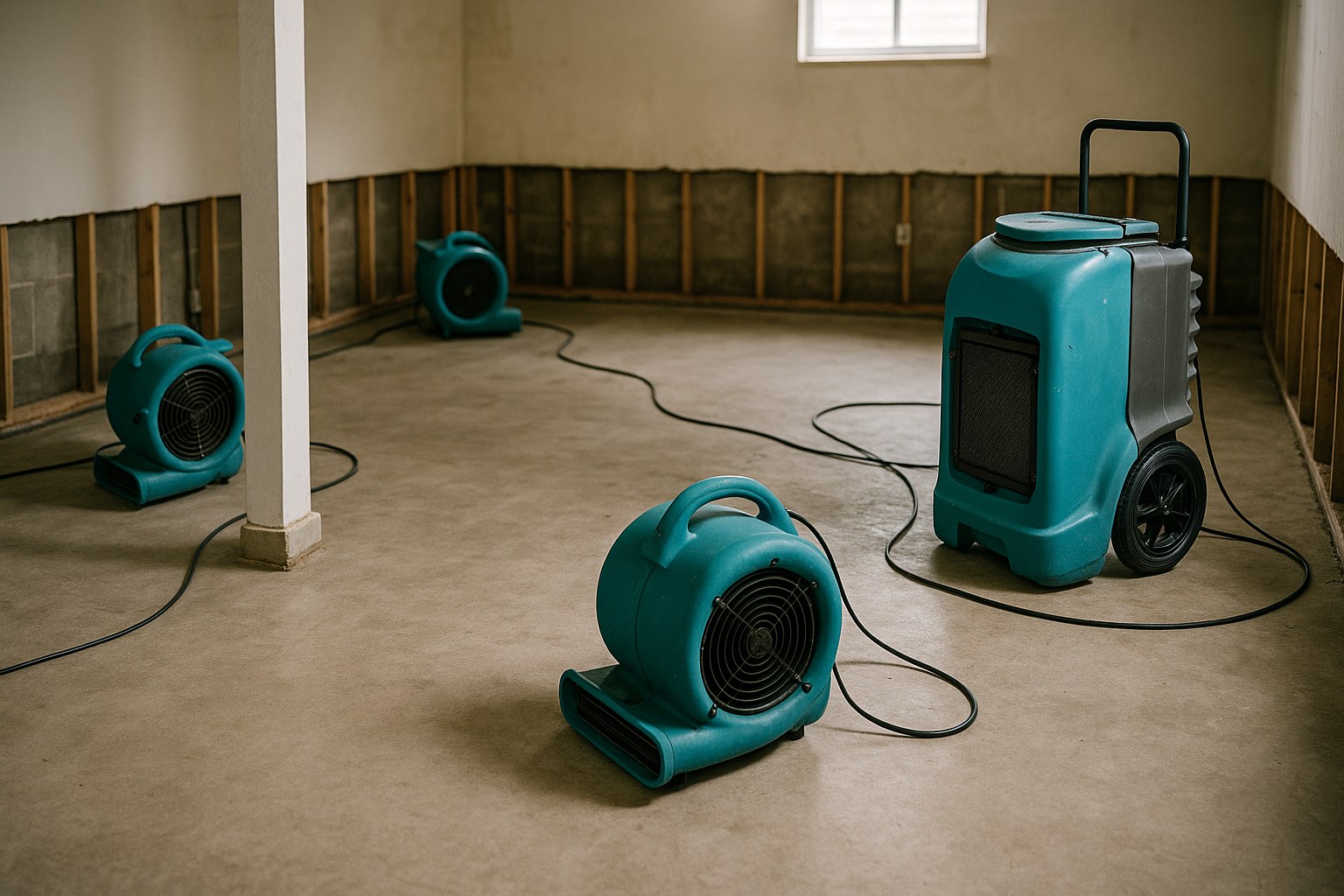
After a Category 3 loss, porous materials that contacted the water are removed rather than dried. That means carpet, pad, insulation, particleboard and MDF, upholstered furniture, and mattresses. Drywall is cut above the waterline — the flood cuts you see in restoration photos are not damage, they are the removal line. Non-porous materials such as concrete, metal, and sealed hard surfaces are cleaned and can generally stay. Contents get triaged item by item, and porous contents usually do not survive a Category 3 loss.
Two things follow from that. First, a Category 3 job includes controlled demolition, which is why reconstruction after the drying is finished is part of the scope rather than a separate project you arrange later. Second, if the source was sewage or another biological contaminant, the cleaning protocol is different from ordinary water damage restoration work and falls under biohazard cleanup procedures, with the containment, protective equipment, and disposal handling that implies.
If it is a sewer backup in Cincinnati, there is a 48-hour clock
This is the piece most property owners here do not know about, and it is time-sensitive enough to mention before the insurance discussion.
The Metropolitan Sewer District of Greater Cincinnati runs a Sewer Backup program for backups caused by the public sewer. According to MSD’s claim filing information, a backup must be reported to MSD within 48 hours of discovery to be considered for potential reimbursement, and the report has to go through MSD’s 24-hour line at (513) 352-4900 or its online form. Once reported, there is a two-year window to submit the completed claim, and MSD says most claimants receive a written decision within 60 days of a complete submission.
A few details worth knowing before you start cleaning. The program applies to backups originating in the MSD public sewer, generally from inadequate capacity or certain maintenance issues; MSD states it does not cover backups caused solely by private plumbing problems or by overland flooding. MSD may provide cleaning services if the property qualifies, and if you hire your own restoration contractor you may be reimbursed depending on eligibility — but MSD does not reimburse self-cleaning. Ohio law requires MSD to deduct private insurance benefits from a claim, so it asks for documentation of your insurance.
Most importantly for the first hour: MSD notes that it does not inventory or estimate property damages as part of its investigation. That is your job, and it has to happen before the damaged contents go to the curb. Photograph everything, including the water line on the wall and the contents on the floor, and write an inventory as you go. Eligibility is MSD’s determination, not your contractor’s, so report first and sort the rest out afterward.
How the category shows up in an insurance claim
The category does not appear as a coverage term in most policies, but it shapes the claim in two ways: it determines the scope of work an adjuster is reviewing, and it usually determines which part of a policy is in play at all.
Broadly, property policies tend to respond to water damage that is sudden and accidental, and to treat long-term seepage differently. Coverage for water backing up through sewers or drains is commonly a separate endorsement rather than something included by default. Damage from rising surface water is generally excluded from standard property policies and handled through separate flood coverage. None of that is a prediction about your situation. Policy language varies between carriers and between policies from the same carrier, and your own declarations page and endorsements govern what you actually have. This article is general information, not legal or insurance advice — read your declarations page and talk to your agent or carrier about your specific policy.
What you can control is documentation. A restoration contractor should be recording the category and the reasoning for it, moisture readings by location, daily drying logs, and photographs of conditions before and during the work. That record is what supports the scope later, and it is far easier to produce while the work is happening than to reconstruct afterward.
What to do before anyone arrives
Assume the water is at least one category worse than it looks until someone establishes otherwise. If the water reached outlets, appliances, or the panel, keep clear of it and have the power to that area shut off. Stop the source if there is a valve you can reach safely.
Then document before you move anything. Photograph the standing water, the water line on the walls, and the contents where they sit. Move undamaged items out of the wet area if you can do so without walking through Category 3 water. Do not throw out damaged contents yet — for an insurance claim and for an MSD claim, both, the items are evidence until they have been inventoried.
If the water sat for more than a day or two in warm weather, or if there was already a musty smell before the loss, expect an assessment for mold remediation alongside the drying work. Finding it early is considerably cheaper than finding it inside a finished wall three months later.
If you are looking at water right now and are not sure what you are dealing with, call TRI-WEH at (513) 231-6653 or reach us here; we are on site within 90 minutes, and the first thing we will do is tell you the category and what it means for your property before any work starts.