



Blog
Contents Pack-Out After a Fire: What to Expect
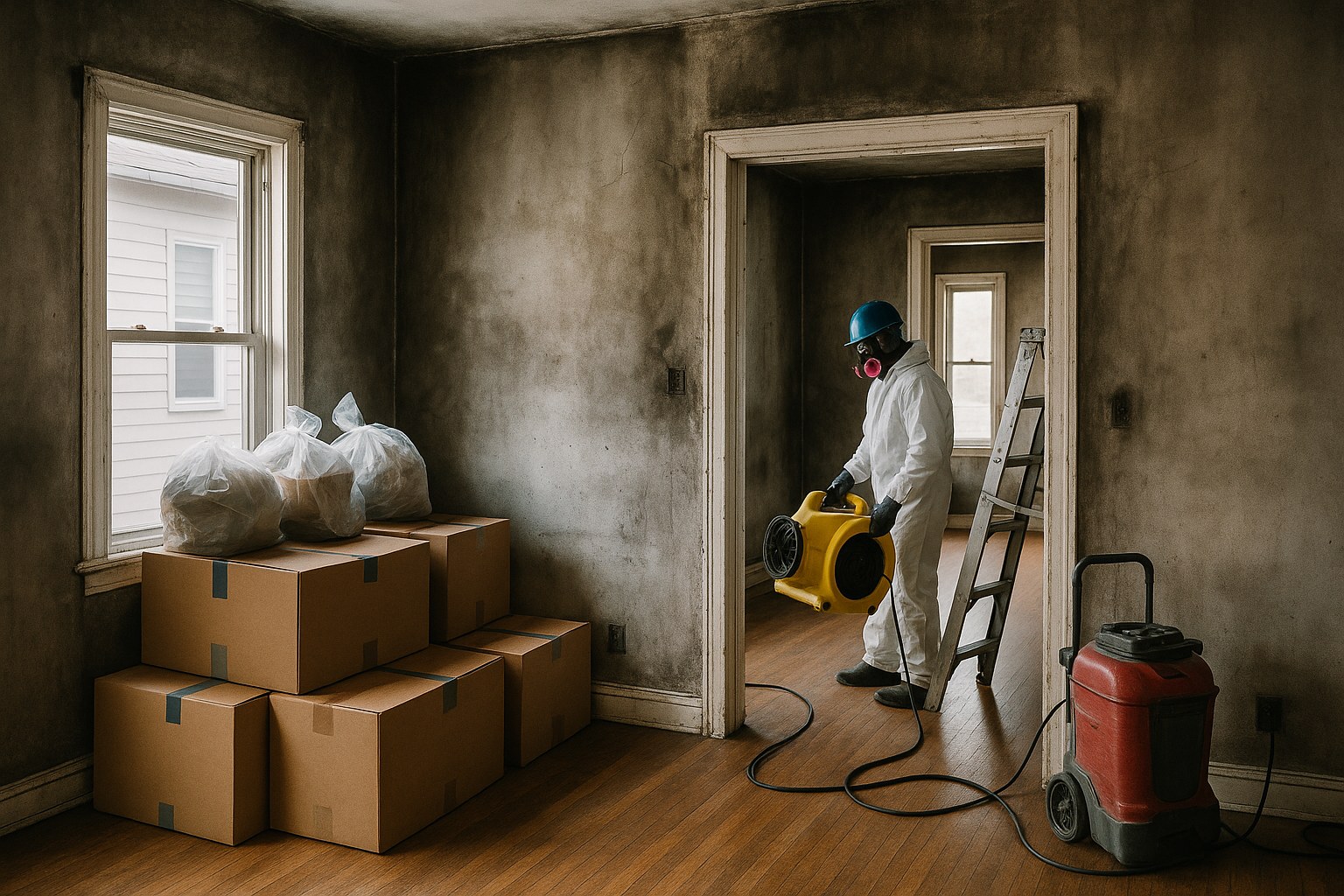
A pack-out is the part of a fire loss nobody explains until it is already happening. A crew arrives, your belongings go into boxes and onto a truck, and the house you were standing in that morning is empty by dinner. This article explains what that process actually is, what happens to your things once they leave, how the inventory feeds your insurance claim, and what usually does not come back. It is written for homeowners and property owners around Cincinnati who are in the first week of a fire loss, or working through the claim weeks later and wondering where their furniture went.
Why your belongings leave before the rebuild starts
There are two reasons, and neither one is about convenience.
The first is that smoke residue does not sit still. It is fine, slightly oily, and on many surfaces chemically active rather than inert, which is why a chrome fixture or a marble sill that looked fine the day after a fire can be permanently etched two weeks later. Electronics are worse, because the residue works its way inside the case and onto the boards. Every day contents stay in a smoke-affected room, the cleaning gets harder and the list of things that can be saved gets shorter.
The second is sequencing. Reconstruction is a dirty process. Flood cuts, drywall removal, sanding, framing and sawing all generate dust, and that dust settles on everything left in the room. Cleaning contents in place before demolition means cleaning them twice. Cleaning them after means they sat in residue for a month first. So contents come out, get processed off-site, and come back once the reconstruction work is finished and the rooms are clean.
This is not a company preference. The current industry standard, ANSI/IICRC S700-2025, Standard for Professional Fire and Smoke Damage Restoration, published in 2025, covers the assessment of fire residues and odors affecting a building, its systems including HVAC, and its contents, and it expects the work to run off a documented Restoration Work Plan rather than improvisation. If a contractor cannot tell you what their plan is for your contents specifically, that is worth asking about before anything is boxed.
The inventory is the claim
Before a single box is taped, your belongings should be recorded. On a well-run fire and smoke damage restoration job that means a room-by-room list, photographs of each area and of individual items that carry value, condition notes, make and model numbers where they matter, and a label or barcode on every box that ties back to a line on the list.
Two lists come out of that. One is the salvageable inventory: what gets cleaned, stored and returned. The other is the non-salvageable list, the itemized record of what was destroyed, and that list is what your contents settlement gets built from. Read it before you sign it. If your grandmother’s dining chairs are on it and you believe they can be saved, that conversation needs to happen while the chairs still exist.
On the policy side, the general shape is worth knowing. The Insurance Information Institute notes that most companies provide personal property coverage at 50 to 70 percent of the amount of insurance on the dwelling, that whether you are paid actual cash value or replacement cost is set out under Section I, Conditions, Loss Settlement in the policy, and that categories such as jewelry, silverware and furs often carry lower caps under Special Limits of Liability. Actual cash value subtracts depreciation; replacement cost does not.
Those are general descriptions of how policies tend to be written, not a reading of yours. Policy language varies between carriers and between forms, and your own declarations page and policy wording govern what you are owed. This article is not legal or insurance advice.
One practical thing you can do in the first hours, before anyone else arrives: walk the house with your phone and photograph every room, every open closet and every drawer you can safely reach. It takes ten minutes and it is the only version of the inventory that exists from your side.
What actually gets cleaned, and how
Contents get sorted by material, not by the room they came from, because material is what determines the method.
- Hard goods such as dishes, glassware, cookware, light fixtures, toys and metal hardware are often run through ultrasonic cleaning, where the item is immersed and high-frequency agitation lifts residue out of crevices a cloth cannot reach.
- Textiles go to specialized laundering or dry cleaning depending on fiber. Natural fibers like cotton and wool generally give up smoke odor more readily than synthetics, which absorb it and hold onto it, so two shirts from the same closet can get different verdicts.
- Soft and porous surfaces are HEPA vacuumed and dry sponged before anything wet touches them, because adding moisture to dry soot turns a surface deposit into a stain.
- Deodorization happens in a sealed chamber off-site rather than in your living room, which is both more effective and keeps treatment away from occupied space.
- Documents and photographs can often be stabilized by freeze-drying when they are also water damaged, and scanned when the original is too far gone to restore.
Worth being plain about: the decision to clean an item rather than replace it is partly economic. Restoration either costs less than replacement or it does not, and that calculation is one of the things the non-salvageable list is recording. A contractor who claims everything is salvageable is not doing you a favor, and neither is one who writes off a houseful of furniture without opening a box. Our before and after gallery shows what restored rooms and contents actually look like coming back.
What usually does not come back
Food is the clearest case, and the rules are stricter than most people expect. USDA Food Safety and Inspection Service guidance on fires and food safety explains that heat alone can wake up spoilage bacteria in canned goods and jars and can cause containers to split or rupture, so cans that sat near a fire may be unsafe even when they look perfect; that a refrigerator seal is not airtight, so fumes reach the food inside; that anything in permeable packaging such as cardboard or plastic wrap exposed to fumes should be discarded; and that the chemicals used to fight a fire cannot be washed off food, though cans and cookware exposed to them can be decontaminated by washing in strong detergent and then dipping in a bleach solution.
Beyond food, the items that most often end up on the non-salvageable list are mattresses and pillows, upholstered furniture whose foam took heavy smoke, plastics that warped in the heat, and electronics that were in a smoke-filled space long enough for the residue to get inside. Electronics are the deceptive category, because a device can power on normally for weeks and then fail. Medicines and cosmetics exposed to heat or smoke are a question for your pharmacist or physician rather than for a restoration crew.
Soot, ash and your own safety during the loss
People go back in. It is understandable, and the EPA has published specific precautions for handling ash and soot that are worth following if you do. Its guidance to protect yourself from ash says to wear a close-fitting NIOSH Approved respirator and notes that surgical masks and one-strap dust masks will not protect you; to avoid dry sweeping or dusting and never to use a leaf blower, dampening surfaces with water first and then wet-mopping; to use a HEPA vacuum where possible; to keep children away and let them back only after affected areas have been cleaned up; and that people with heart or lung disease, older adults and pregnant women should not take part in ash cleanup at all.
Two things no honest restoration contractor will tell you. Nobody walking through your house can tell you whether something you are feeling is related to smoke exposure; that is a question for a physician, and worth asking sooner rather than later if you have any concern. And no cleaning or remediation should ever be sold to you as removing a health risk. The work removes residues and odors from building materials and belongings, which is a different claim.
Where your things live until the house is ready
Salvageable contents go into secured, climate-controlled storage, tracked against the inventory, and come back to their original rooms once structural repairs are done. Before you sign the authorization, there are five questions worth asking: where is it stored, is that space climate controlled, who has access to it, is it insured and under whose policy, and how do you retrieve a single item mid-project when you need a document or a winter coat.
A fire loss is rarely only a fire loss, which affects how long storage runs. The water used to put the fire out is still in the structure, and wet building materials support mold growth within days, so water damage restoration and sometimes mold remediation usually run alongside the fire work. Smoke travels through the HVAC system too, and ductwork that carried smoke needs assessment before the system runs again, which is where duct cleaning fits into a fire job rather than being an upsell bolted onto it.
The claim clock, on the Ohio side
Ohio sets deadlines its insurers have to work to. Under Ohio Administrative Code 3901-1-54, an insurer must acknowledge receipt of a claim within fifteen days of being notified, or provide the necessary claim forms and complete instructions inside that same window; must respond within fifteen days to a communication from a claimant that calls for a response; must decide whether to accept or deny within twenty-one days of receiving a properly executed proof of loss, or explain inside that period why it needs more time; must then keep the claimant updated in writing at least every forty-five days; and must pay an accepted, undisputed amount no later than ten days after acceptance.
That rule is Ohio law, so it applies to a loss in Madeira, Mariemont or Mason but not across the river. Readers in Covington or Edgewood are under the Kentucky Department of Insurance, and readers in Aurora under the Indiana Department of Insurance, each with its own timelines and complaint process. Knowing which regulator covers your address matters more than it sounds, and this is a description of how the rules are written rather than advice about your claim; for that, talk to your agent, an attorney, or your state’s insurance department.
Why this is worth reading in October
Fire Prevention Week ran October 4 to 10 this year, and NFPA built the 2026 campaign around safe charging and lithium-ion battery fires. It lands when it does for a reason. NFPA’s Home Heating Fires research, using 2019 to 2023 data, puts the average at about 38,881 home fires a year involving heating equipment, with 432 civilian deaths, 1,352 injuries and $1.1 billion in direct property damage, peaking between December and February, and space heaters and heating stoves involved in 29 percent of them.
Which means the losses this article describes start climbing in the Ohio Valley in a few weeks, not in spring. The week your furnace comes back on and the first fire goes in the fireplace is the right week to walk the house with your phone, photograph the rooms and the closets, and email the file to yourself so it lives somewhere other than the building. It costs nothing, and it is the single thing that makes a contents claim easier later.
If you are in the first week of a fire loss right now, the call that matters is the one that gets your belongings documented and out before demolition starts, and TRI-WEH’s crews answer around the clock across the tri-state at (513) 231-6653.