



Blog
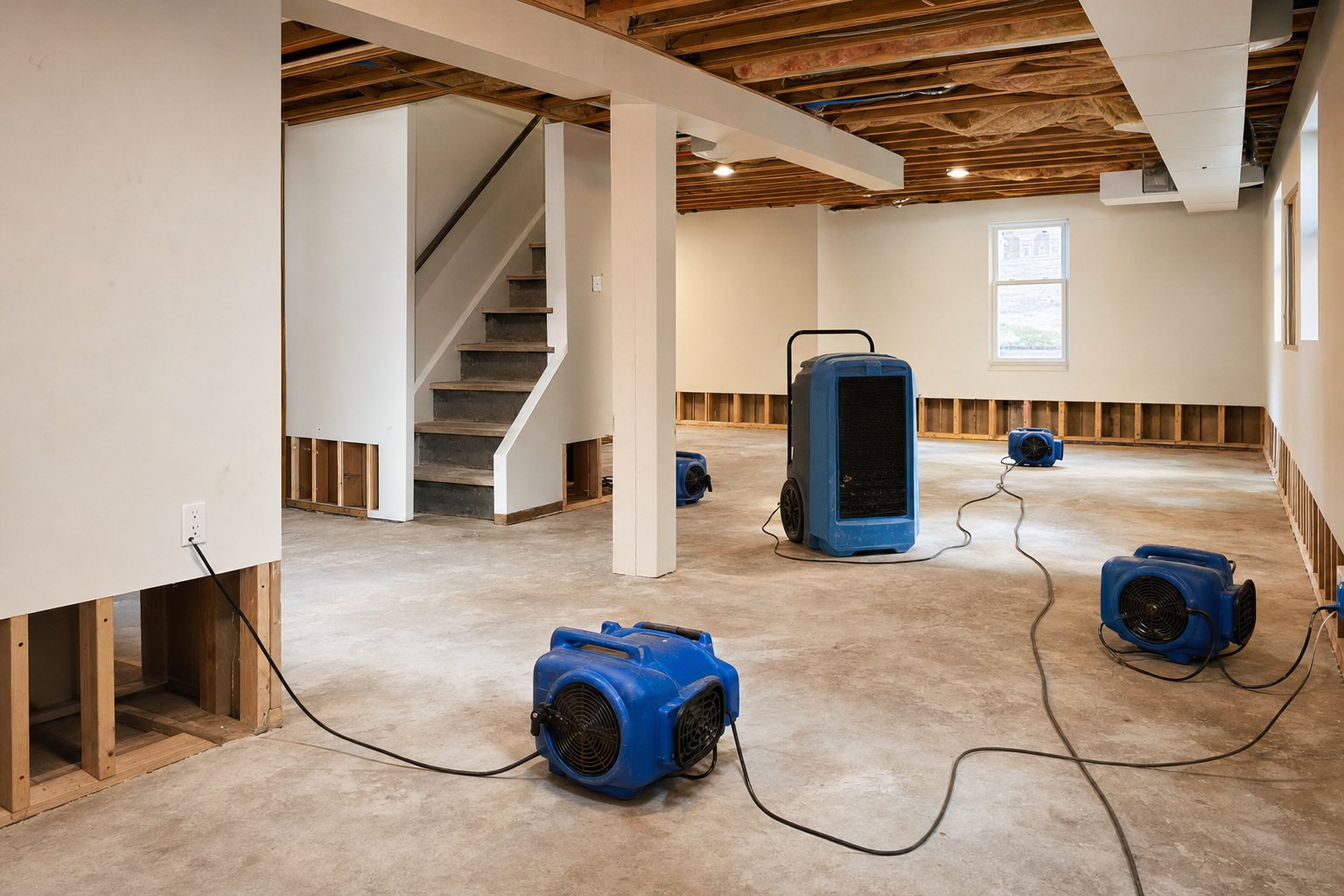
Water Damage Drying Equipment: Why It Goes Where It Goes
If a pipe let go in your house this week, there is now a row of equipment running in rooms you cannot use, it is loud, and nobody has explained why the fans are aimed at the baseboards instead of at the wet floor. This is how a restoration crew decides what goes where, how long it stays, and what you should leave alone. It works the same way for a burst supply line in Loveland and a failed water heater in Green Township.
The short answer: the equipment count comes from the geometry of the wet area, not from the size of the puddle. Air movers are placed to push air across wet surfaces. Dehumidifiers are sized to pull out the water those surfaces release. Both numbers start from a formula and then get corrected by what the moisture meters read each day.
What is actually sitting in your rooms
A residential dry-out usually involves three kinds of machine, and they are not interchangeable.
- Air movers are the low, snail-shaped fans against the walls. They do not dry anything by themselves. They break up the thin layer of damp, still air that clings to a wet surface so that moisture can leave the material and enter the room air.
- Dehumidifiers are the larger boxes with a hose running to a drain or a sink. They take the moisture the air movers released and remove it from the house. On most residential jobs this is a low grain refrigerant unit, which is why a crew may call it an LGR.
- Air scrubbers are the units with a filter stack, used when the water was contaminated or when demolition is producing dust. They handle air quality, not drying.
Those first two work as a pair. Air movers without enough dehumidification just move wet air around and raise the humidity in the rest of the house. Dehumidification without air movement dries the room air while the inside of your wall stays wet. The ratio between them is the whole job, and it is the part of professional water damage restoration that is hardest to see from the outside.
How the number of air movers is decided
The industry reference is ANSI/IICRC S500, the consensus standard for water damage restoration. Its approach to initial equipment is built on wall length rather than floor area, because walls are usually where the water went. The common starting rule is one air mover for every 10 to 16 linear feet of affected wall, with at least one additional unit for each small bathroom, closet, or wall offset, according to a walkthrough of the S500 method published in Restoration and Remediation magazine.
Run that on a real room. A 12 by 12 foot bedroom has 48 linear feet of wall, which calls for four to five air movers on its own. That is why one modest bedroom can end up with five machines in it and why the number climbs so fast once water has crossed into a hallway and two more rooms. The same source notes that the final count also depends on how quickly the crew got there, what the materials are, how porous they are, and the conditions in the house that day.
Where this surprises people is upstairs losses. A supply line that fails on a second floor in Symmes Township drains down through ceilings, so the wet surfaces include the ceiling and the upper walls of the room below. Those get their own equipment, which is why a first-floor room with a perfectly dry floor can still fill up with fans.
Why the fans face the wall, not the puddle
Standing water is extracted, not evaporated. By the time equipment is set, the water you could see is gone and the water that matters has wicked up into drywall paper, down into the subfloor, and along the sill plate. That is the surface the air has to reach.
So air movers are set almost touching the wall, angled roughly 15 to 45 degrees along it, with every outlet pointed the same direction so the air travels the perimeter of the room in one continuous sweep rather than colliding in the middle. An industry review of placement practice is blunt that the arithmetic alone is not enough: the units have to be aimed at surfaces the moisture readings show are genuinely wet, and the daily readings have to support the number of machines billed to the room, as Accuserve sets out in its guidance on validating air mover placement.
That is also the honest test of whether your crew is doing this properly. If the fans are parked in the middle of the floor pointing at nothing in particular, or if there are nine of them in a room where only one wall got wet, the setup is decorative. Ask to see the sketch and the readings the count came from. Reputable crews keep both, and many will show you the before and after documentation from similar jobs.
How the dehumidifier is sized
Dehumidifier sizing uses volume, not wall length, and it depends on how much of the room absorbed water. The S500 sorts losses into four classes, from Class 1, where very little material absorbed anything, up to Class 4, which covers specialty drying of dense materials like hardwood, plaster, and concrete that release water very slowly.
For a typical Class 2 loss dried with LGR equipment, the method is to take the room volume in cubic feet and divide by 50 to get the pints per day of capacity required, then divide that by the rated capacity of the units on hand. A 30 by 50 foot space with 8 foot ceilings is 12,000 cubic feet, which calls for about 240 pints per day, or four 65-pint units or two 140-pint units, per the same Restoration and Remediation walkthrough. Capacity is quoted as an AHAM rating, a standardized figure that lets two different machines be compared honestly.
This is why the dehumidifier often is not in the wettest room. It is sized to the air volume of the drying chamber as a whole, and it is placed where it can pull from that whole volume and still reach a drain.
Why the doors stay shut and nothing gets switched off
A dry-out works by creating a closed drying chamber. The crew decides which doors stay shut, which stay open, and whether plastic sheeting goes up, so that the dehumidifier is conditioning a known volume of air instead of the whole house and the weather outside. Opening a window in the middle of that undoes the arithmetic.
The equipment also runs continuously for a reason that is easy to underestimate. Every hour the materials are wet is an hour the drying has to recover, and the clock is short. The EPA advises drying water-damaged areas and items within 24 to 48 hours to prevent mold growth, and states that if wet areas are dried in that window after a leak, mold will usually not grow (EPA, A Brief Guide to Mold, Moisture and Your Home). Switching the machines off overnight because they are loud is the single most common way a three-day job becomes a mold remediation job.
On the health question, be careful what you accept from anyone, including a contractor. The EPA notes in the same guide that molds have the potential to cause health problems, that exposure can irritate the eyes, skin, nose, throat, and lungs, and that research on mold and health effects is ongoing. It also states plainly that no EPA or other federal limits have been set for mold or mold spores, so there is no such thing as a certified safe spore count, and any number presented to you as one should be questioned. Nobody walking through your house can tell you whether symptoms you are having are caused by what is in it. If you have a health concern, that is a conversation for your physician. And no amount of drying or cleaning should ever be sold to you as removing a health risk.
What changes when the loss happens in November
Winter dry-outs behave differently, and this is the season for them. The first freeze has already arrived across most of the region: the National Weather Service office in Wilmington puts the normal first 32 degree reading at October 25 for both Cincinnati and Covington, with a freeze having occurred by November 5 in nine years out of ten (NWS Wilmington fall frost and freeze climatology, 1991 to 2020). The spread across the area is wider than people expect. Milford’s normal first freeze is October 18, a full week ahead of the airport, which is the kind of local variation that decides whether an exposed line in an unheated crawl space made it through October. Local forecasts had much of the Tri-State at or near freezing over this weekend, the coldest morning so far this season.
Three things change once it is cold. The house is sealed, so there is no option to ventilate and the dehumidifier is doing all of the work. Your furnace is now part of the drying system, which is useful, because warm materials release moisture faster than cold ones, and crews will often ask you to hold the thermostat steady rather than setting it back at night. And if the water came from a frozen line, the wet area is frequently a crawl space, an exterior wall cavity, or a ceiling below an unheated attic run, none of which look like a flooded basement and all of which need equipment pointed into places you cannot see.
Housing stock matters here too. A finished basement in a 1960s Colerain Township or Taylor Mill house is the slow case, because carpet over pad over slab, with framed and insulated walls, is a stack of layers and the middle of the stack dries last. A Brookville house on a crawl space is a different job again, closer to a confined space exercise than a room dry-out. And if the water ran through supply ductwork, that duct run becomes part of the problem rather than part of the solution, which is one of the narrow situations where duct cleaning is genuinely warranted rather than routine.
What you should and should not touch
Short list, in order of how much trouble it saves.
- Do not unplug or reposition equipment. If a unit is in a doorway you need, call the crew and have them move it and note the change.
- Do not turn anything off at night. If the noise is genuinely unlivable, say so, because the answer is sometimes quieter equipment or a different chamber layout, not fewer machines.
- Watch your breakers. A residential circuit will not carry five air movers and an LGR, and crews distribute loads across circuits for that reason. A tripped breaker in an unused room can silently stop a day of drying.
- Leave doors and windows as the crew set them, and keep the thermostat where they asked.
- Empty nothing. If a dehumidifier is draining to a sink or condensate pump, that is deliberate and monitored.
- Take your own photographs before anything is moved, and again as work progresses.
The daily log, and why it matters later
Someone should be in the house every day, taking temperature and relative humidity readings and moisture content readings from the same marked locations. The S500 expects monitoring at least daily, with psychrometric conditions and moisture content recorded, and expects the drying approach to change if the readings do not show satisfactory progress. That is also how equipment leaves: not on a schedule, but when the wet materials read the same as equivalent dry materials elsewhere in the house.
Those daily records are the evidence behind the mitigation side of an insurance claim, because equipment charges are generally billed per unit per day. A file with a dimensioned sketch, equipment photographs, and a complete daily log is a file an adjuster can approve. A file with none of that invites questions nobody can answer weeks later. How any of it is actually covered depends entirely on your own policy: coverage for water losses varies considerably between carriers and forms, your declarations page and policy wording govern, and this article is general information rather than legal or insurance advice. Your carrier or a licensed agent is the right source for what your specific policy does.
Once drying is signed off, the mitigation phase ends and the repair phase begins, and they are separate pieces of work with separate estimates. Replacing the drywall, flooring, and trim that came out falls under reconstruction and construction services, and it should not start until the readings say the structure behind it is dry.
If equipment is running in your house right now and you are not sure the setup matches the damage, ask the crew for the sketch, the equipment list, and today’s readings, and compare the air mover count against the wall footage of the rooms that actually got wet. If you would rather have someone look at it, TRI-WEH Restoration answers around the clock at (513) 231-6653.