



Blog
Managing Large-Scale Flood Cleanup in Commercial Facilities: A Practical Plan
Managing Large-Scale Flood Cleanup in Commercial Facilities: A Practical Plan
Large-scale flooding in a commercial facility is rarely “just water.” It can mean contaminated runoff, damaged electrical systems, compromised structural materials, and downtime that quickly becomes a financial emergency. A practical flood cleanup plan must balance life safety, regulatory requirements, and the realities of restoring operations in warehouses, retail centers, healthcare buildings, multi-tenant offices, and light industrial sites. TRI-WEH Restoration approaches these events with a disciplined workflow that prioritizes hazard control, rapid stabilization, and documentation from the first hour through final verification.
1) Stabilize the Site: Safety First, Access Second
Before any equipment is rolled in, the facility must be evaluated for immediate hazards. Flood events often create hidden risks: energized circuits, weakened flooring, displaced chemicals, or sewer-contaminated water. Restrict access to affected zones, post signage, and establish a single controlled entry point for personnel and materials.
- Shut down power where water intrusion is present; coordinate lockout/tagout with facility maintenance and qualified electricians.
- Check for structural concerns (bowed walls, saturated ceiling systems, undermined slabs) and restrict loads from forklifts or scissor lifts until cleared.
- Confirm water category and potential contaminants; treat unknown water as potentially hazardous until tested or traced.
- Issue appropriate PPE: waterproof boots, gloves, eye protection, and respiratory protection when aerosols, dust, or microbial growth are possible.
2) Build the Cleanup Plan: Zones, Priorities, and Documentation
Large commercial losses succeed or fail on coordination. Establish work zones (clean, transition, contaminated), define traffic patterns to prevent cross-contamination, and set priorities based on business continuity. Critical areas—server rooms, electrical rooms, production lines, and tenant spaces with high-value inventory—typically move to the top of the list.
Documentation should begin immediately: photos, moisture readings, equipment logs, and daily progress notes. This supports insurance claims, compliance requirements, and internal decision-making. An IICRC certified project lead helps ensure that drying plans, monitoring, and verification align with recognized industry standards.
3) Rapid Water Removal: Scale Matters
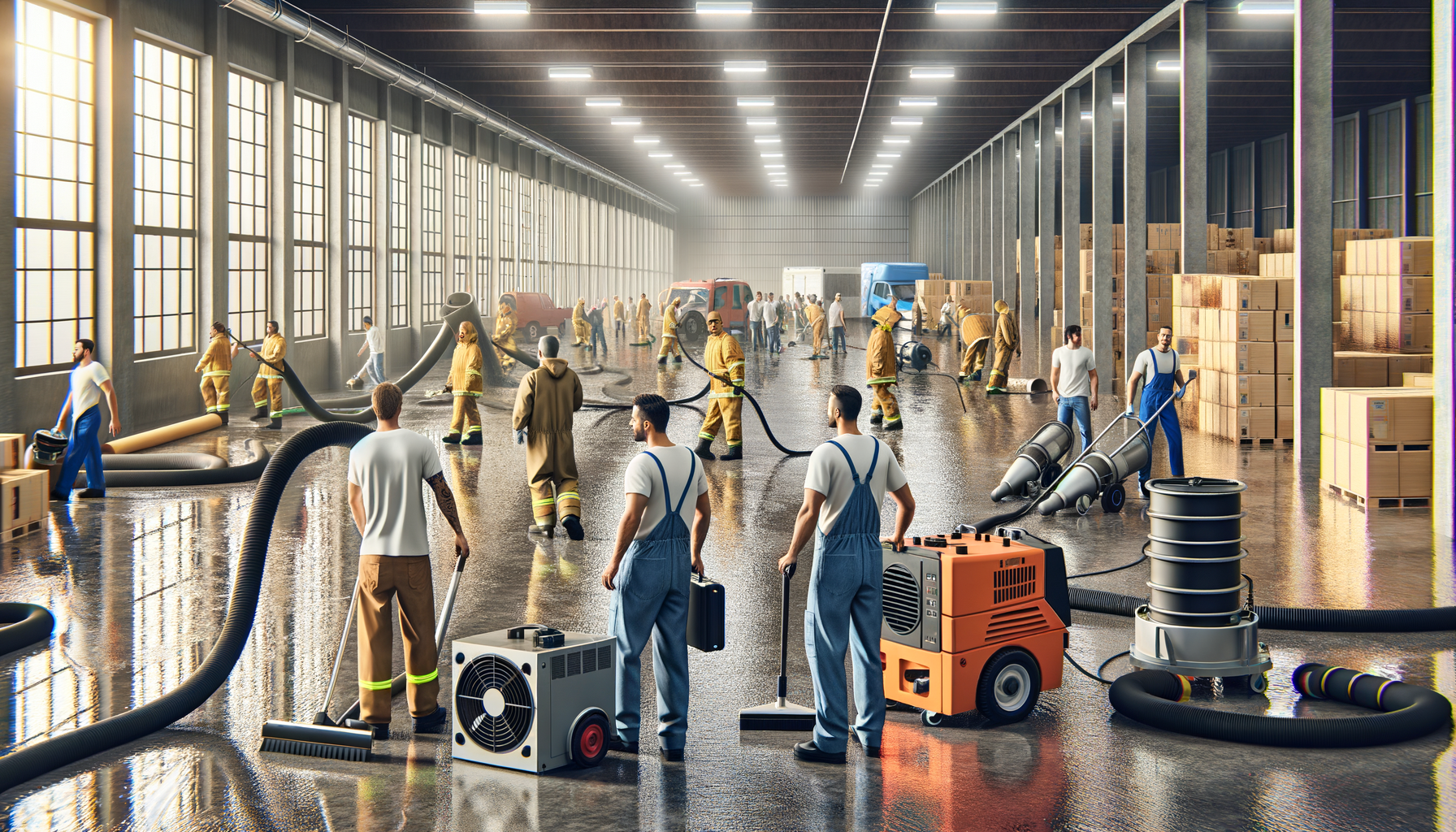
In big-box spaces and industrial facilities, the difference between a manageable event and a long shutdown is how fast bulk water is removed. High-capacity water extractors, truck-mounted systems, and pumps are deployed based on depth, access, and discharge options. The goal is to eliminate standing water quickly to reduce migration into walls, insulation, and subfloors.
- Use squeegees and floor scrubbers to move water toward extraction points in wide-open areas.
- Confirm safe discharge locations and local requirements; avoid sending contaminated water into storm drains.
- Remove saturated materials that cannot be economically dried (collapsed ceiling tiles, soaked insulation, delaminated composites).
4) Drying and Dehumidification: Control the Environment, Not Just the Floor
After extraction, drying becomes a building science problem: temperature, humidity, airflow, and material composition. Large facilities often require multiple dehumidification units, air movers, and sometimes temporary power distribution to maintain consistent performance across long distances and varied room conditions.
Daily monitoring is essential. Moisture mapping, psychrometric readings, and targeted invasive checks (when necessary) confirm whether drying is progressing or if hidden reservoirs remain. In multi-tenant buildings, isolate unaffected suites to prevent humidity migration and protect indoor air quality.
5) Cleaning and Sanitizing: From Hard Surfaces to Soft Goods
Floodwater leaves behind soils, microbes, and residues that can create odors and health concerns. Hard surfaces are cleaned and, when appropriate, treated with antimicrobial solutions based on water category and material compatibility. Soft goods require special attention: carpet, upholstery, and acoustic materials can trap contaminants and slow drying.
Professional carpet cleaning may be viable when the water source is clean and response is immediate; however, contaminated water often necessitates removal and replacement. Decisions should be made quickly to avoid wasting drying days on materials that will not pass post-clean verification.
6) Prevent Secondary Damage: Mold and Odor Control
Time and humidity drive microbial growth. If conditions have been wet for more than a short window, implement measures to prevent amplification: maintain dehumidification targets, remove unsalvageable porous materials, and use containment when disturbing suspect areas.
Facilities in the Ohio region sometimes request specialized support such as mold remediation Cincinnati services when flood conditions overlap with pre-existing moisture issues. When mold is present or suspected, containment, HEPA filtration, and clearance criteria should be established early to avoid rework.
Odor is another common complaint after a flood, especially when organic debris or sewage is involved. Addressing smoke odor is well known in restoration, but the principle applies here: remove the source first, then treat remaining odor molecules through appropriate cleaning and controlled deodorization methods.
7) Recommissioning and Verification: Make Reopening Defensible
Before reopening, confirm that the facility is not only dry, but safe and functional. That includes verifying moisture levels in structural materials, ensuring HVAC systems are clean and operating correctly, and confirming that electrical and fire protection systems are inspected and restored. Final cleaning, touch-up repairs, and a documented walkthrough with stakeholders help align expectations and reduce post-reopen issues.
A practical large-scale flood cleanup plan is built on speed, safety, and measurable progress. With the right equipment, disciplined monitoring, and an experienced, IICRC certified team, commercial facilities can stabilize faster, reduce secondary damage, and return to operations with confidence.