



Blog
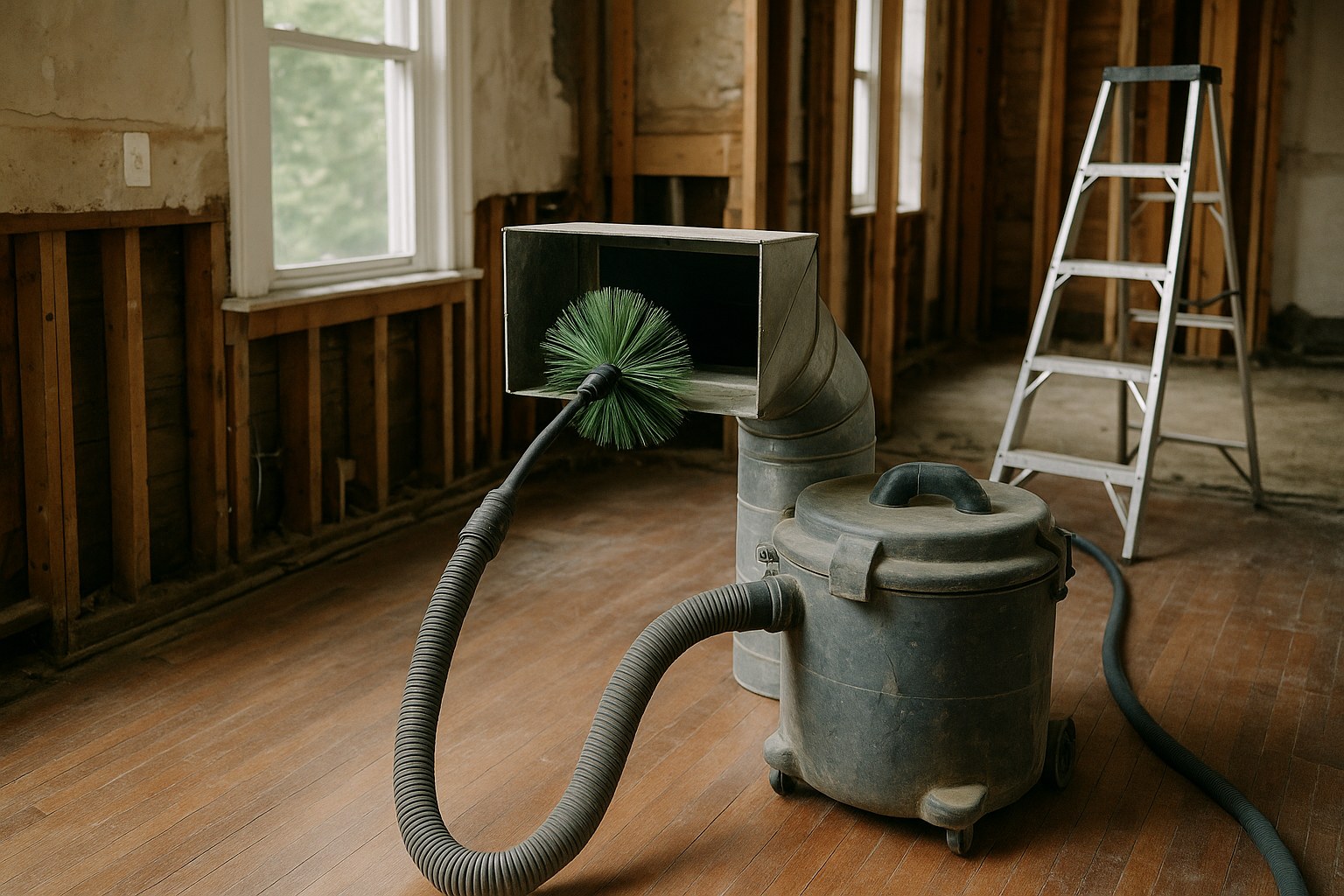
When Air Duct Cleaning Is Actually Necessary
Most homes do not need their air ducts cleaned. The U.S. Environmental Protection Agency is direct about it: EPA does not recommend that air ducts be cleaned routinely, but only as needed. That single sentence contradicts most of what you will hear from a phone solicitor offering a whole-house special, and it is the right place to start if you are trying to decide whether the work in front of you is necessary.
This is a practical guide to the situations that do warrant cleaning a residential HVAC system, the situations that do not, and what a legitimate scope and quote look like in southwest Ohio, Northern Kentucky and southeast Indiana. It is written for property owners deciding whether to spend the money — and for anyone who has just been through a fire, a burst pipe or a basement backup and is trying to work out what the system needs now.
The three conditions EPA says justify cleaning
EPA names three circumstances in which duct cleaning is warranted: substantial visible mold growth inside hard-surface ducts or on other components of the heating and cooling system; ducts infested with vermin such as rodents or insects; and ducts clogged with excessive amounts of dust and debris, or particles actually being released into the home from the supply registers (EPA, Should You Have the Air Ducts in Your Home Cleaned?).
Notice how specific those are. Not “it has been a few years.” Not dust on the register grille, which is the part you can reach with a vacuum yourself. EPA also states plainly that duct cleaning has never been shown to actually prevent health problems, and that there is no evidence a light amount of household dust in air ducts poses any risk to your health. If you have health concerns, those belong with your physician, not with a duct cleaning quote.
After a fire, the answer is usually yes
Fire is the clearest case. Smoke does not stay in the room where it started. If the system was running, or if the blower cycled on at any point during or after the fire, soot and combustion residue get pulled into the return and distributed through the supply runs. You then have a contaminant sitting on every interior duct surface, and every time the furnace runs afterward it redistributes some of it into rooms the fire never touched.
That is why duct work belongs in the scope of a fire loss rather than being treated as an optional add-on. A house in Norwood with a kitchen fire confined to one wall can still have odor complaints in the upstairs bedrooms three weeks later, and the system is usually why. Sequence matters too: the ducts should be addressed alongside contents cleaning and before any reconstruction work closes up walls and ceilings, because access is far easier before the drywall goes back. If you are working through a smoke loss now, the details of that sequence are covered in our fire and smoke damage restoration work.
After a water loss, it depends on what your ducts are made of
This is the distinction that catches people out, and it is worth understanding before anyone quotes you.
Sheet metal ducts that got damp can usually be cleaned and dried. Ducts that are internally lined with fiberglass insulation, and flexible duct with an insulated core, are a different problem. EPA’s position is unambiguous: if you have insulated air ducts and the insulation gets wet or moldy, it cannot be effectively cleaned and should be removed and replaced. Cleaning is not an option for that material. Replacement is.
That matters a great deal in this region, because so much of our ductwork runs through basements and crawlspaces — exactly the spaces that take on water first. A finished basement in Delhi Township or Fort Thomas with trunk line and flex runs below the joists can come through a supply-line failure with the drywall dried successfully and the duct insulation still holding moisture. If a contractor quotes you a cleaning for wet fiberglass-lined duct, ask why replacement is not on the estimate. The same question applies after a sewage backup, where the concern is contamination rather than moisture alone. Our water damage restoration scopes handle the system as part of the structure, not as a separate sale.
What late September actually smells like
Here is the seasonal one, because we get these calls every year starting about now. Cincinnati’s normal high slides from 73°F at the beginning of October to 60°F by the end of it, with normal lows dropping from 51°F to 40°F over the same four weeks (NWS Wilmington, 1991–2020 normals for CVG). Somewhere in that slide, everyone turns the heat on for the first time since spring.
And it smells. A warm, slightly scorched, dusty smell for the first twenty or thirty minutes of the first few cycles. In the large majority of cases that is household dust that settled on the heat exchanger and burner assembly over the summer burning off — not a duct problem, and not a reason to book a cleaning. It should fade within a cycle or two. What is worth attention is a smell that does not fade, a burning-plastic or electrical smell, or a musty smell that gets stronger when the system runs. The first two are reasons to call an HVAC technician; the last one is discussed below.
A related seasonal note for anyone in Blue Ash or Erlanger who had renovation work done over the summer: construction and demolition dust is one of the few genuinely good reasons to clean a system, and drywall dust in particular is fine enough to pass through a standard filter and coat the interior of the duct. If the work was done with the registers unsealed, the system is worth looking at before heating season gets going.
Mold in the system: what can and cannot be said
Visible mold growth inside hard-surface ducts is one of EPA’s three conditions, so if that is what you are seeing, cleaning is appropriate — and so is finding the moisture that caused it, because growth will return otherwise. CDC’s guidance is that remediation requires making the necessary repairs to prevent further water entry, and that wet materials should be dried within 48 hours of getting wet or removed (CDC/NIOSH, Mold, Testing, and Remediation).
Two things are worth knowing before you agree to testing. First, CDC/NIOSH does not recommend routine air sampling for mold as part of building air quality evaluations, and states there are no health-based standards for mold or other biological agents in indoor air; measured spore counts cannot be interpreted in relation to health risks (CDC/NIOSH). So there is no federal number a contractor can test you against, and any quote built on getting your count under a threshold is built on something that does not exist. Second, CDC notes that exposure to damp and moldy environments may cause a variety of health effects, or none at all, and that people with asthma or mold allergies, and people who are immune-compromised, may be affected differently from others (CDC, About Mold).
What that means practically: nobody inspecting your ductwork — us included — can tell you whether a symptom you are experiencing is or is not related to mold in your home, and no remediation should be sold to you as removing a health risk. Those are questions for your physician. What a contractor can properly do is find the moisture source, contain the work area, remove the growth and the materials that cannot be cleaned, and document it. That is the substance of mold remediation, and it is a different job from a duct cleaning, even when the two overlap.
One more EPA point, because it comes up in sales calls: no chemical biocides are currently registered by EPA for use in internally-insulated air duct systems. If someone proposes fogging or “sanitizing” your lined ductwork as part of the job, that is the question to ask.
What a real quote looks like
EPA puts typical duct cleaning cost in the range of $450 to $1,000 per heating and cooling system, varying with system size, accessibility and the level of contamination. A $69 or $99 whole-house price does not cover that work, and the gap is usually closed with add-ons once the crew is inside.
Things worth seeing in writing before you sign:
- The whole system in scope — supply and return runs, registers and grilles, the plenum, the blower compartment, the coil and the drain pan. Cleaning the runs and skipping the air handler leaves the reservoir in place.
- How access will be made and how openings will be resealed afterward. Proper cleaning means cutting access into the duct; that is expected, and closing it correctly is part of the job.
- Source removal — physically extracting debris under negative pressure — rather than a vacuum held at the register.
- Which materials are being cleaned and which are being replaced, specifically, if any lined duct or flex has been wet.
- A named certification. The industry credential is NADCA’s Air Systems Cleaning Specialist, which is examined and renewed annually; the corresponding work standard is NADCA’s ACR standard. Ask who on the crew holds it.
- Before and after photographs of the interior of the duct, not of the grille.
A note on insurance, since duct work often lands inside a claim: whether the cleaning or replacement of ductwork is covered depends on the cause of loss and on your specific policy language, which varies between carriers and between policies from the same carrier. Your own declarations page and policy form govern. This article is general information, not legal or insurance advice.
You have three business days to cancel
Duct cleaning is sold at the door and over the phone more than almost any other home service, and all three states in this market give you a cancellation window on those sales.
In Ohio, a buyer has the right to cancel a home solicitation sale until midnight of the third business day after the day the buyer signs the agreement, and the seller must give written notice of that right (ORC 1345.22); the definition excludes transactions under $25 (ORC 1345.21). Kentucky gives the same three business days from signing for a home solicitation sale (KRS 367.420). Indiana allows cancellation until midnight of the third business day after the later of the date the supplier gives the required notice or the date the contract is finalized, for transactions with a cash sales price of at least $25 (IC 24-5-10-8).
So a homeowner in Lawrenceburg or Batesville who agreed to something at the door on a Monday has until Thursday midnight to put the cancellation in writing. Nothing about that requires an argument — it is a statutory right, and a reputable company will not be surprised by it. Again: general information, not legal advice; if a dispute is under way, talk to an attorney or your state attorney general’s consumer protection office.
The short version
If your system has visible mold on hard surfaces, vermin, or enough debris that it is visibly coming out of the registers, cleaning is warranted. If you have just had a fire, it almost certainly is. If you have had a water loss, the question is whether your duct is metal or lined, because lined material that got wet gets replaced rather than cleaned. If none of that applies and someone is telling you it has just been too long, EPA’s position is that routine cleaning is not recommended. Free duct cleaning inspections are worth exactly what they cost when the inspector is paid on what they sell.
If you are looking at a system after a fire, a water loss or a backup and want a straight answer about whether it needs cleaning, replacement or nothing at all, call us at (513) 231-6653 and we will tell you which one it is.